10 Reasons Your Organic Fertilizer for Tomatoes Isn't Working (And How to Fix It)

You’ve done everything by the book. You bought the expensive organic fertilizer, you’ve been diligent with the watering schedule, and you’ve even talked to your plants (no judgment here). Yet, your tomato plants look like they’re stuck in a perpetual state of "meh." Maybe they are lush and green but have zero fruit, or perhaps they look spindly and yellow despite your best efforts.
The truth is, even the best plant food can fail if the underlying chemistry of your soil and water isn't addressed. In the world of plant nutrition, it’s rarely about a lack of macronutrients (N-P-K) and more often about the biological and mineral roadblocks that keep those nutrients from reaching the plant.
Here are 10 scientific reasons why your fertilizer for tomatoes isn't delivering the results you expected, along with practical ways to fix it.
1. The "Green Giant" Syndrome (Nitrogen Overload)
It’s a common mistake: assuming that more growth equals a healthier plant. High-nitrogen organic fertilizers promote rapid vegetative growth. While this creates beautiful, dark green leaves, it often inhibits the plant from entering its reproductive phase.
When nitrogen levels are too high, the plant "forgets" to flower. Scientifically, this is an imbalance in the carbon-to-nitrogen ratio within the plant tissue. Furthermore, excessive nitrogen creates tender, succulent growth that acts as a magnet for pests like aphids.
The Fix: Use a balanced fertilizer during the early stages, but once you see the first yellow flowers, transition to a formula higher in phosphorus and potassium.
2. The Micronutrient Gap (The Missing Trace Minerals)
This is the single most overlooked aspect of plant nutrition. Most organic fertilizers focus on the "Big Three" (Nitrogen, Phosphorus, Potassium), but plants require over 70 different trace minerals to complete their metabolic processes. These minerals act as catalysts for enzyme production. Without them, your plant is like a car with a full tank of gas but no spark plugs.
Trace minerals like boron, manganese, and zinc are essential for fruit set and flavor profile. If your soil is depleted, no amount of N-P-K will fix the underlying deficiency.
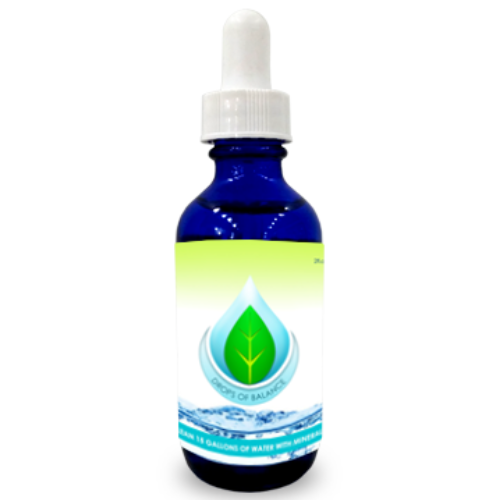
The Fix: Supplement your watering routine with a concentrated mineral solution. Drops of Balance 2 oz provides the essential ionic minerals that act as the "key" to unlocking nutrient uptake.
3. Tap Water Sabotage (Chlorine and Chloramines)
You might be killing your garden with "kindness" every time you turn on the hose. Most municipal water is treated with chlorine or chloramines to kill bacteria. While great for preventing human illness, these chemicals are indiscriminate: they also kill the beneficial soil microbes required to break down organic fertilizer.
If your soil biology is dead, your organic fertilizer just sits there. It’s not bioavailable until microbes process it.
The Fix: Treat your water before it hits the soil. Using a mineral-based water treatment can help neutralize harmful chemicals while adding back the minerals that tap water lacks. Explore our water treatment collections to protect your soil’s microbiome.
4. Soil pH and Nutrient Lockout
Chemistry 101: the pH of your soil determines the solubility of nutrients. For tomatoes, the sweet spot is a pH of 6.2 to 6.8. If your soil is too acidic or too alkaline, nutrients become "locked." They are physically present in the soil, but the plant’s roots cannot chemically "grab" them.
For example, at a high pH, iron and phosphorus become unavailable, leading to yellowing leaves and stunted growth regardless of how much organic fertilizer you apply.
The Fix: Test your soil pH. If it’s off, use elemental sulfur to lower it or lime to raise it. More importantly, using mineral salts in an ionic form can help buffer the root zone and improve uptake efficiency.
5. Lack of Microbial Diversity (The BAM Factor)
Organic fertilizer is not plant food; it is microbe food. Microorganisms like mycorrhizae and bacteria must digest organic matter to turn it into an ionic form that roots can absorb. If your soil is "sterile" due to previous chemical use or poor water quality, your fertilizer is useless.
 Visual: A microscopic view of healthy soil mycelium and bacteria interacting with plant roots.
The Fix: Inoculate your soil. Using a product like BAM (Beneficial Active Microbes) introduces a diverse colony of microbes that work in synergy with minerals to maximize plant nutrition.
6. The "BAM!" Effect: Mineral vs. Untreated Growth
When we look at plant trials, the difference between "standard" organic feeding and "mineral-enhanced" feeding is stark. Minerals don't just help the plant; they support the microbial life that supports the plant. This creates a feedback loop of health.

As seen in the comparison above, plants treated with a combination of minerals and microbes (BAM) exhibit significantly more robust root structures and leaf density compared to those receiving standard treatment.
7. Temperature-Induced Stasis
Sometimes, it’s not the fertilizer: it’s the weather. Tomatoes are sensitive to thermal extremes. If daytime temperatures exceed 90°F or nighttime temperatures stay above 75°F, the plant enters a survival mode. Pollen becomes sterile, and the plant stops moving nutrients to the fruit to conserve moisture.
The Fix: Use mulch to keep root temperatures stable and consider provide afternoon shade during extreme heat waves. Ensure your plants have adequate minerals to strengthen their cellular walls against heat stress.
8. Phosphorus Lockout via Calcium Competition
In many organic setups, gardeners add high amounts of calcium (like crushed eggshells) to prevent blossom end rot. However, excessive calcium can compete with phosphorus and magnesium for uptake. This "ion antagonism" means that by over-correcting for one problem, you’ve created another.
The Fix: Instead of dumping bulk minerals, use a balanced mineral solution that maintains the correct ionic ratios. Check out the Drops of Balance collection for a more scientific approach to mineral balance.
9. Poor Cation Exchange Capacity (CEC)
CEC is a measure of how well your soil can hold onto nutrients. Sandy soils have low CEC; the fertilizer just washes away. Heavy clay has high CEC but can hold nutrients too tightly. If your soil can't "hold and release" nutrients effectively, your best plant food is essentially being wasted.
The Fix: Increase organic matter through high-quality compost or peat-free alternatives like PittMoss to improve soil structure and exchange capacity.
10. The Delivery System: Ionic vs. Complex Molecules
Plants don't eat "compost." They "drink" ions: individual elements like $K^+$, $NO_3^-$, and $Mg^{2+}$. Large organic molecules in fertilizers must be broken down into these tiny ionic forms. This takes time and energy. If your plant is under stress, it doesn't have the energy to wait for this process.
 Visual: An infographic showing a plant root absorbing ionic minerals vs. a blocked organic molecule.
The Fix: Use minerals that are already in a sulfate-based, ionic form. This allows for immediate absorption, especially during the critical fruiting stage.
Conclusion: Why Minerals are the "Secret Sauce"
The most common reason an organic fertilizer for tomatoes fails is that the gardener is treating the plant like a machine rather than a living biological system. You cannot simply "add fuel" (N-P-K) and expect performance if the engine (microbes) is compromised and the oil (minerals) is missing.
By focusing on high-quality water, a diverse microbial population, and a full spectrum of trace minerals, you give tomatoes a much better shot at producing the kind of healthy vines and beautiful fruit every gardener wants to see.
If you want to learn more about supporting soil biology and water quality, visit our About Us page or review our latest safety testing results.