
How to Improve Soil Health in 5 Minutes: The Water Treatment Secret for Organic Gardeners
If you’ve spent any time in the organic gardening world, you’ve heard the mantra: "Feed the soil, not the plant." We spend months obsessing over compost ratios, brewing stinky teas, and layering mulch like it’s a high-stakes game of Lasagna. But here is the irony: most gardeners are inadvertently sabotaging their soil health every time they pick up the hose.
Improving soil health is usually a long game. It takes seasons to build tilth and years to develop a robust fungal network. However, there is one "secret" that takes exactly five minutes and fundamentally changes the biological trajectory of your garden. It’s all about water treatment for plants.
In this deep dive, we’re going to look at why your tap water might be the silent killer of your soil microbes and how a few drops of ionic sulfate minerals can turn your garden into a high-performance ecosystem.
The Invisible Saboteur: Why Tap Water Kills Soil Life
To understand how to improve soil, we first have to stop breaking it. Most municipal water is treated with chlorine or chloramine to kill bacteria. This is great for preventing cholera in humans, but it’s a localized apocalypse for the beneficial bacteria and mycorrhizal fungi in your garden.
When you pour untreated tap water onto your organic beds, you are essentially applying a mild antibiotic to your soil’s "gut." Over time, this kills off the very microorganisms responsible for nutrient cycling. If the microbes die, your expensive organic fertilizers just sit there, unavailable to the plant.
But the chemical cocktail doesn’t stop at chlorine. Modern tap water often contains fluoride, heavy metals, and: increasingly: traces of glyphosate (the active ingredient in Roundup) that leach into the groundwater from industrial farming.
The 5-Minute Solution: Enter Drops of Balance
This is where the "5-minute fix" comes in. Instead of just letting your water sit out (which is often ineffective for chloramine), you can actively treat and mineralize it.
Drops of Balance uses a concentrated solution of ionic sulfate minerals to transform tap water. The process is based on flocculation, a well-established water treatment mechanism in which charged particles attract and bind contaminants. In practical terms, these minerals help bind unwanted substances such as heavy metals and other residues, reducing their interference with soil biology and plant development.
By treating your water, you are not just making it cleaner. You are making it more compatible with the living system in your soil.
The Science of Soil Microbes and Mineralization
Organic gardening is not just about avoiding synthetic inputs; it is also about supporting biological function in the soil. Soil is a dynamic ecosystem made up of bacteria, fungi, organic matter, minerals, water, and air. For plants to thrive, they need more than Nitrogen, Phosphorus, and Potassium (NPK). They also rely on trace minerals that support enzymatic activity and normal physiological processes.
How Glyphosate Impacts Soil
Glyphosate is a potent chelator. In plain English, that means it grabs onto minerals and locks them up, making them unavailable to the plant. It also disrupts the "shikimate pathway" in microorganisms. When glyphosate residues from municipal water enter your soil, they act as a "lock" on the nutrient pantry.
Adding the "Missing" Minerals
Drops of Balance adds over 70 trace minerals back into the water. When you provide these minerals in an ionic (electrically charged) form, the plants can absorb them almost instantly. More importantly, the soil microbes: the "engine" of your garden: use these minerals to build their own cellular structures and perform the heavy lifting of breaking down organic matter.
Why Most Organic Fertilizers Fail
Ever noticed that you can add expensive organic fertilizer to a bed and not see much happen? No obvious growth spurt, no major color change?
This usually happens for two reasons:
- The Microbes are Dead: There’s no "workforce" to process the fertilizer.
- Mineral Deficiency: The plant doesn't have the trace elements needed to build the enzymes that transport those nutrients.
When you use water treatment for plants that includes ionic minerals, you are providing the "spark" that starts the fire. You are re-mineralizing the soil while protecting the delicate microbial balance.
The "BAM!" Factor: Pairing Mineralization with Inoculation
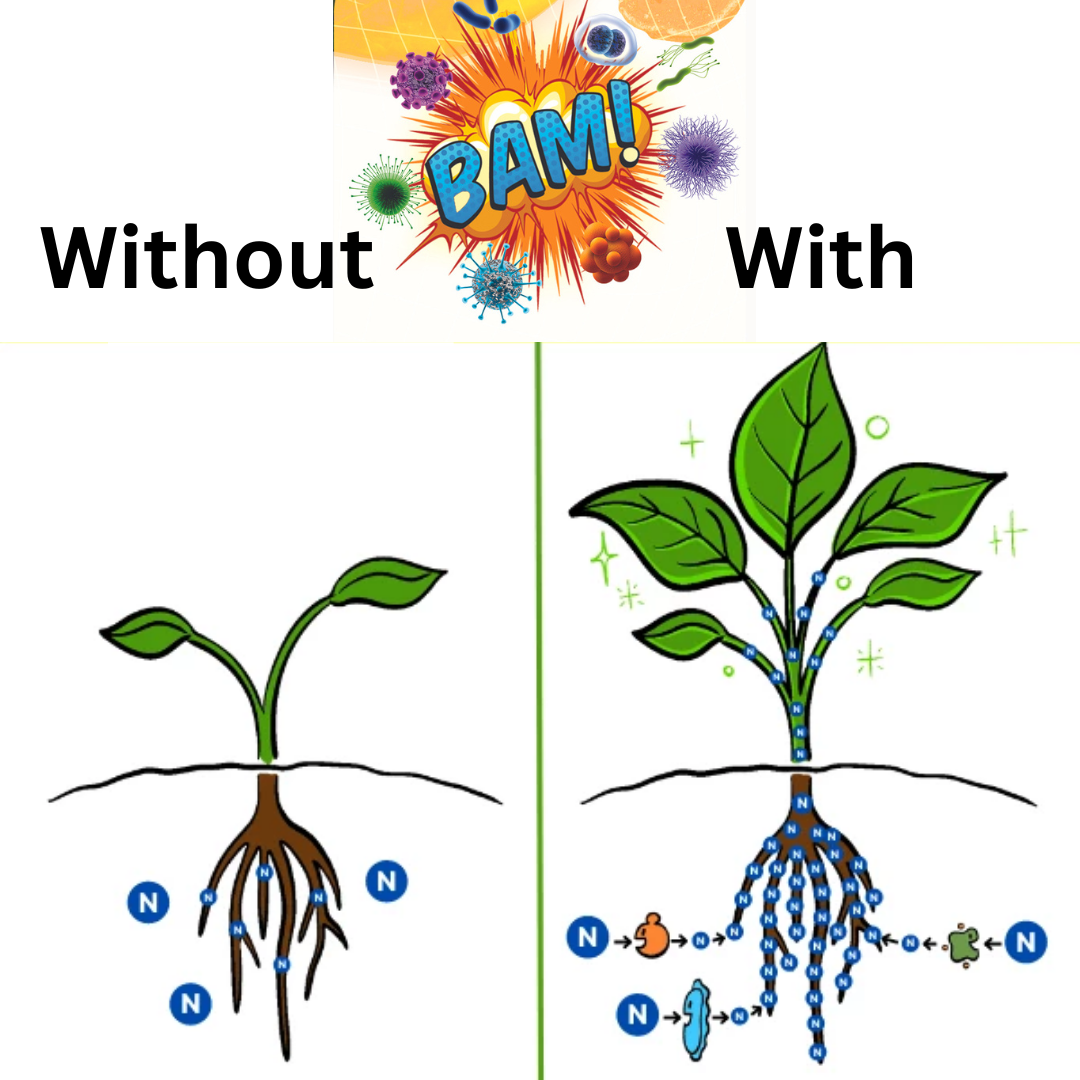
If you want to move from "healthy soil" to "super-soil," you need to combine clean, mineral-rich water with high-quality microbial inoculants. At Drops of Balance, we often recommend the "BAM!" (Beneficial Ancient Microbes) approach.
While the minerals in Drops of Balance clean the water and provide the fuel, a product like BAM! provides the workers. These are beneficial microorganisms that have been specifically cultured to thrive in mineral-rich environments.

In the comparison above, you can see the difference. On the left, a plant watered with standard tap water struggles with nutrient lockout and poor microbial colonization. On the right, a plant treated with the mineral solution and microbial inoculants shows robust root development and dark, chlorophyll-rich foliage.
Steps to Improve Your Soil in 5 Minutes
Here is exactly how you do it. No tilling, no digging, no waiting six months for a compost pile to break down.
- Grab your watering can: Fill it with standard tap water.
- Add Drops of Balance: For a standard 2-gallon watering can, you only need about 2ml of the concentrate. (Check our FAQ for specific dilution ratios).
- Stir and Wait: Give it a quick stir. Within minutes, you’ll notice the water might look slightly cloudy as the minerals begin to flocculate the toxins.
- Water your plants: Pour this mineral-rich, toxin-free water directly onto the soil at the base of your plants.
- Repeat: Do this every time you water.
By following this simple routine, you are consistently flushing toxins out of your soil and replacing them with the building blocks of life. This is the most efficient way to improve soil health without a massive labor investment.
The Long-Term Benefits of Better Water
Once you make the switch to mineralized water treatment, the long-term effects on your organic gardening efforts are profound:
- Improved Water Retention: Healthy soil with high microbial activity holds onto water more effectively, meaning you have to water less often.
- Pest Resistance: Plants with a full spectrum of trace minerals develop thicker cell walls and stronger "immune systems," making them less attractive to pests.
- Higher Nutrient Density: If it’s not in the soil, it’s not in your food. By adding 70+ trace minerals to your water, you ensure your homegrown vegetables are actually as healthy as they look.
Taking the Next Step
If you're serious about improving plant nutrition and soil health, it makes sense to look at water quality as part of the whole system. Water, minerals, microbial activity, and soil structure all work together, and small changes in one area can affect the others.
Gardening does not have to feel like a constant fight against poor soil. Sometimes the better move is not adding more inputs, but improving the quality of the water moving through the system in the first place.
Spend a few minutes treating your water, stay consistent, and watch how your soil responds over the course of the season.