
10 Reasons Your Fertilizer for Tomatoes Isn’t Working
For many gardeners, the tomato plant is the ultimate litmus test of horticultural success. We invest in high-quality organic fertilizer, maintain strict watering schedules, and monitor for pests, yet often find ourselves staring at lush green foliage with zero fruit, or worse, plants that appear stunted and yellow despite regular feeding.
When "best-in-class" plant nutrition fails to produce results, the issue rarely lies in the quantity of fertilizer applied. Instead, the failure is typically found in the biological and chemical hurdles that prevent a plant from accessing those nutrients. This is known as nutrient lockout or metabolic stagnation. To achieve a nutrient-dense harvest, one must understand the complex synergy between soil chemistry, water quality, and mineral availability.
Here are 10 scientifically-backed reasons why your fertilizer for tomatoes isn’t working and how to correct the course.
1. Excessive Nitrogen During the Reproductive Phase
Nitrogen is essential for vegetative growth, providing the building blocks for chlorophyll and leaf structure. However, tomatoes follow a distinct physiological timeline. If a high-nitrogen organic fertilizer is applied after the plant has reached its flowering stage, the plant receives a hormonal signal to remain in "growth mode" rather than "reproductive mode."
This leads to a beautiful, dark green plant with massive leaves but very few blossoms. Research indicates that applying excessive nitrogen during the fruiting stage can even cause "blossom drop," where the plant prematurely sheds its flowers to focus energy on foliage. For optimal results, transition to a fertilizer higher in phosphorus and potassium once the first fruit set appears.
2. The Missing Link: Trace Mineral Deficiency
Most commercial fertilizers focus heavily on the "Big Three" (Nitrogen, Phosphorus, and Potassium). While these are vital, they represent only a fraction of what a tomato plant requires for cellular health. Trace minerals: such as Boron, Zinc, Manganese, and Molybdenum: act as enzymatic co-factors.
Think of N-P-K as the "gas" in the tank, while trace minerals are the "spark plugs." Without Boron, for instance, a tomato plant cannot effectively move sugars or develop healthy pollen tubes, leading to poor fruit set regardless of how much N-P-K is in the soil. Utilizing a solution like Drops of Balance ensures your water is enriched with these essential trace elements, preventing the "Law of the Minimum" from capping your garden’s potential.
3. Soil pH Imbalance and Nutrient Lockout
Soil pH is a logarithmic scale that measures the acidity or alkalinity of the environment. Tomatoes thrive in a slightly acidic range (6.2 to 6.8). When the pH strays outside of this window, chemical reactions occur that physically "lock" nutrients in the soil, making them insoluble and unavailable to the roots.
Even if you apply the most expensive organic fertilizer, a low pH (below 6.0) will specifically prevent the uptake of Phosphorus and Calcium. Conversely, a high pH (above 7.5) will lock out Iron and Manganese. Regular testing is required to ensure your plant nutrition efforts aren't being neutralized by an invisible chemical wall.
4. The Calcium-Water Transport Paradox
Blossom-end rot is the bane of tomato growers, appearing as a dark, leathery patch on the bottom of the fruit. While this is a calcium deficiency, it is rarely caused by a lack of calcium in the soil. Instead, it is usually a transport issue.
Calcium is a non-mobile nutrient; it moves through the plant via transpiration (the movement of water from roots to leaves). If watering is inconsistent: periods of extreme dryness followed by flooding: the plant cannot maintain a steady flow of calcium to the developing fruit. For more on how water quality affects this process, see how mineralized water creates nutrient-dense harvests.
5. Chlorine and Chloramine in Tap Water
Most municipal water is treated with chlorine or chloramines to kill pathogens. While effective for human safety, these disinfectants are non-discriminatory; they also kill the beneficial bacteria and fungi in your soil.
Organic fertilizers rely on soil biology to break down complex organic matter into "plant-available" ionic forms. When you water with untreated tap water, you are effectively sterilizing your soil, leaving your fertilizer sitting there like "unchewed food." Using a mineral-based water treatment to neutralize these chemicals is essential for maintaining a living soil ecosystem.

6. Lack of Microbial Diversity (The Rhizophagy Cycle)
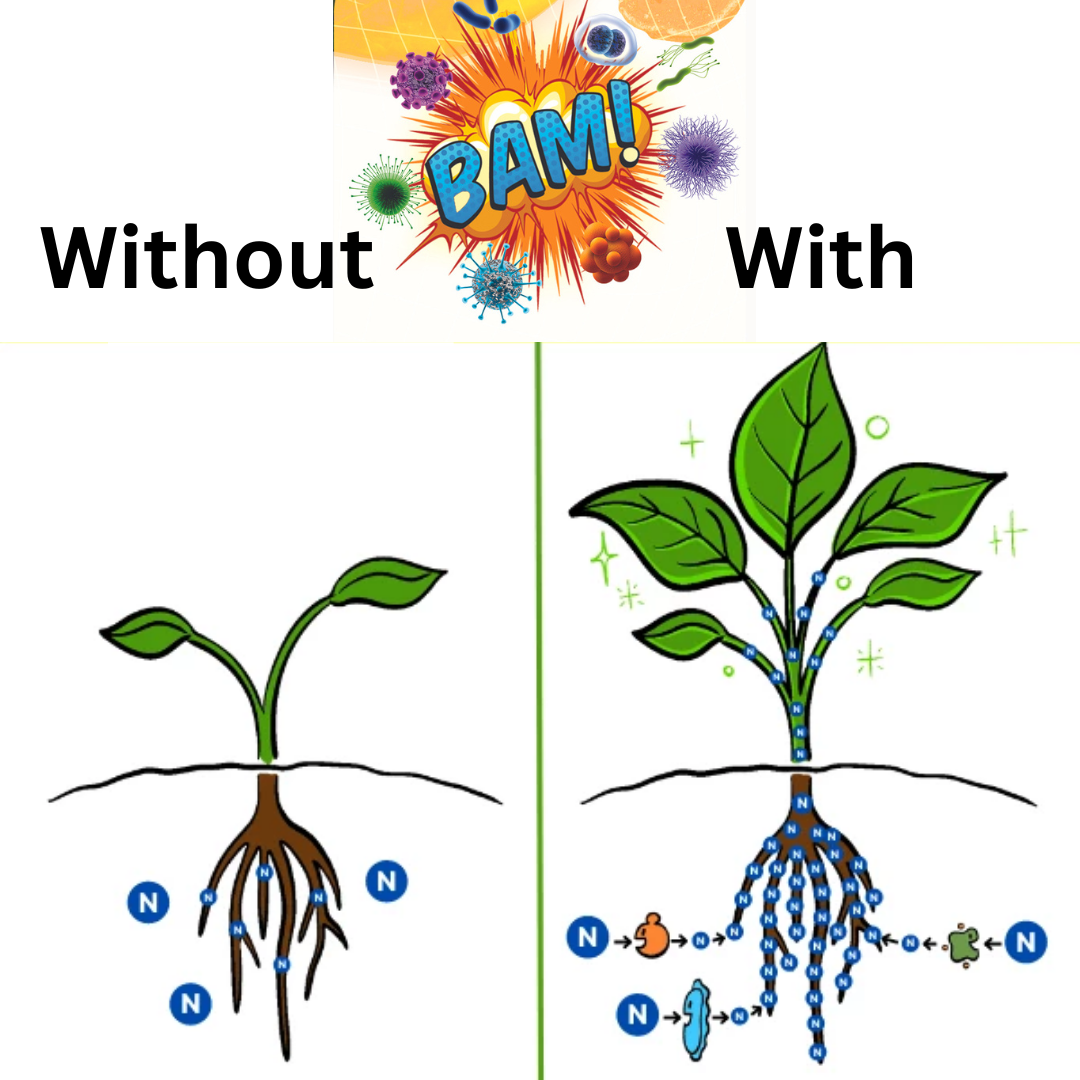
In a healthy garden, plants don't just "suck up" nutrients. They engage in the rhizophagy cycle, where roots actually "eat" microbes to internalize nutrients. If your soil lacks microbial diversity, the nutrient uptake efficiency of your tomato plants can drop by as much as 50%.
Introducing a microbial inoculant, such as BAM! Microbial Inoculant, helps re-establish this biological bridge. These microbes work in tandem with trace minerals to solubilize minerals and protect roots from pathogens.
7. Nutrient Antagonism
In plant nutrition, more is not always better. Many minerals are antagonistic, meaning an excess of one will block the absorption of another. For example:
- Excessive Potassium (K) can block the uptake of Magnesium (Mg).
- Excessive Phosphorus (P) can interfere with Zinc (Zn) and Iron (Fe) uptake.
A balanced approach is critical. Rather than "slugging" the soil with heavy doses of a single nutrient, a consistent supply of balanced minerals provides a stable environment for the plant to select what it needs.
8. Temperature and Metabolic Slowdown
Plant metabolism is heavily dependent on ambient and soil temperatures. In the early spring or late fall, soil temperatures may remain too low for the chemical reactions necessary for nutrient uptake to occur.
If you are gardening in the shoulder seasons, be aware that phosphorus, in particular, becomes very difficult for plants to absorb in cold soil, often turning tomato leaves purple. Ensuring your soil health is maintained year-round is a vital "off-season secret" that pays dividends in the spring. You can learn more about this in our guide on why soil health never sleeps.
9. Heavy Metal Interference and PFAS
Recent environmental research has highlighted the impact of "Forever Chemicals" (PFAS) and heavy metals in domestic water supplies. These contaminants can occupy the exchange sites on root hairs that are normally reserved for beneficial minerals like Calcium and Magnesium.
When a plant absorbs lead or aluminum instead of vital trace minerals, its metabolic pathways become clogged, leading to poor growth and lower-quality fruit. Filtering and treating your water with Drops of Balance helps precipitate these harmful elements out of the water before they ever touch your soil.
10. Improper Fertilizer Timing and Placement
Finally, the physical application of fertilizer for tomatoes matters. Applying fertilizer directly against the stem can cause salt burn, damaging the very tissue responsible for transport. Furthermore, fertilizing too early (before the plant has an established root system) often leads to nutrient leaching: where the fertilizer simply washes away into the subsoil before the plant can reach it.
For optimal efficiency, wait until the first fruit sets, then apply a balanced, mineral-rich feed every two weeks. This ensures the plant has the energy required to sustain fruit production without the risk of vegetative overgrowth.
Summary: A Holistic View of Plant Nutrition
If your tomato garden is struggling, stop looking only at the N-P-K numbers on the bag. Successful gardening is an exercise in synergy. It requires clean, mineral-rich water, a thriving microbial community, and a balanced pH.
By addressing the "hidden" factors: like chlorine in your tap water or the lack of trace minerals in your soil: you unlock the full potential of your fertilizer for tomatoes. Transitioning from a "feeding the plant" mindset to a "building the environment" mindset is the key to a legendary harvest.
To explore our full range of water and soil treatments, visit our complete collection and start giving your plants the clean, mineralized foundation they deserve.